01 / The short answerMost people need the 15.
If you are clearing out a house, stripping one room, or filling a can with ordinary household junk, the 15-yard is the right size for most jobs. Go to the 20 for a full-house cleanout, a roof, or storm debris. Take the 10 only when the driveway is too tight for anything bigger — not to save money, because it usually doesn't.
That is the honest version. Here is the longer one, because the size on the label is only half of what you are buying.
Pick by the job
| Size | Price | Weight included | Roughly | Right for |
|---|---|---|---|---|
| 10 yard | $425 | ½ ton | 3 pickup-truck loads | One bathroom, a single garage bay, a tight driveway |
| 15 yard | $465 | 1 ton | 4–5 pickup-truck loads | A whole room stripped out, a big yard clearance |
| 17 yard | $495 | 1 ton | 5 pickup-truck loads | Multi-room clear-out, flooring across a house |
| 20 yard | $550 | 2 tons | 6 pickup-truck loads | Full house cleanout, roof tear-off, storm debris |
Anything over the included weight is $95 per ton, billed on the landfill ticket. The first 50 miles out of Lakeland are in the price; past that it is $185 out to 85 miles. Full terms are on the quotes and pricing page.
02 / The part that catches people outWeight decides it, not volume.
Every dumpster has two limits: how much it holds and how much it can legally carry down the road. People book on the first one and get caught by the second.
A 20-yard can holds 20 cubic yards of anything. But 20 cubic yards of broken concrete weighs about 38 tons, and no truck on any road is taking that. So the real question is not "will it fit" — it is "what does the stuff I'm throwing away actually weigh?"
| What you're throwing out | One cubic yard weighs about | Hits the 20-yard's 2 tons at |
|---|---|---|
| Household junk, furniture, boxes | 150–400 lb | ~14 cubic yards — nearly a full can |
| Yard waste and brush, no dirt | 400–700 lb | ~7 cubic yards — a third full |
| Drywall | 500–750 lb | ~6 cubic yards |
| Asphalt shingles | 2,400–2,600 lb | ~1.5 cubic yards |
| Dirt, soil, sod | 2,000–3,000 lb | ~1.5 cubic yards |
| Concrete, brick, asphalt | 3,500–4,200 lb | ~1 cubic yard |
You are buying tons, not yards. One cubic yard of broken concrete is close to two tons on its own — the entire allowance on a 20-yard can, in a pile you could cover with a tarp. This is not a Precision thing; it is true of every roll-off in Florida. The difference is that the overage rate is printed above rather than discovered on the invoice.
Heavy material is exactly the case where you should text a photo to (813) 812-3844 first. It takes thirty seconds and it is the cheapest phone call of the whole job.
03 / Roof tear-offWhat size dumpster for a roof?
Roofers measure in squares — one square is 100 square feet of roof. That is the number to size against, because shingles are heavy and volume runs out long after weight does.
Manufacturer figures put three-tab shingles at roughly 190 lb per square and architectural (laminate) shingles under 230 lb, and you add about 10 lb per square for underlayment, nails and the debris that comes with a tear-off. Call it 200 lb per square for three-tab and 240 lb for architectural, one layer.
| Can | Weight included | Three-tab | Architectural |
|---|---|---|---|
| 10 yard | ½ ton | ~5 squares | ~4 squares |
| 15 yard | 1 ton | ~10 squares | ~8 squares |
| 17 yard | 1 ton | ~10 squares | ~8 squares |
| 20 yard | 2 tons | ~20 squares | ~16 squares |
A single-storey house of 1,800 to 2,200 square feet usually works out at 20 to 26 squares once you allow for pitch and overhang. On architectural shingles that is 4,800 to 6,240 lb — so a 20-yard can covers the first 4,000 lb and the rest lands at $95 a ton. In practice, roughly $40 to $105 of overage on a typical single-layer tear-off, and about double that if there are two layers up there.
That is not a surprise charge. It is the number, in advance, so you can put it in the quote instead of finding it later.
Roofing contractors running repeat tear-offs: the swap-out is usually the thing that matters more than the size. Call and ask about same-day exchanges.
04 / 10 or 15When the small can is the wrong buy.
The 10-yard is $425 with half a ton included. The 15-yard is $465 with a full ton. Forty dollars buys five more cubic yards and double the weight allowance.
Which means the arithmetic usually goes one way. Go one ton over on the 10-yard and you have paid $425 plus $95 — $520, for less can than the $465 fifteen would have given you. Ordinary household junk runs about 275 lb per cubic yard, so a 10-yard filled to the rails lands near a full ton on its own. Half a ton is not much room.
When the space says so, not the price. A narrow driveway, a townhouse with no frontage, a job squeezed beside a neighbour's car, a downtown lot where the truck has one place to set it down. In those cases the 10 is not the cheap option — it is the only option that fits, and it earns its place.
It is also right for genuinely light, genuinely small jobs: one bathroom stripped out, a single garage bay, a shed cleared. If that is the job, take it.
05 / Before you fill itWhat can't go in.
Household junk, furniture, appliances, yard and storm debris, construction and remodel debris, roofing tear-off and general clear-outs are all fine. These are not:
- Paint, solvents, fuel, oil and other liquid chemicals
- Asbestos and anything containing it
- Propane tanks, gas cylinders and other pressurised containers
- Batteries, vehicle or household
- Medical or biological waste, including sharps
- Ammunition, explosives and flares
The landfill won't take them and neither can we, legally. If prohibited material turns up in a load after collection you'll hear about it, and the disposal cost gets passed on at cost — not marked up. The full list and the rest of the terms are on the what we can and can't take section.
Not sure about something? Text a photo to (813) 812-3844 before the can arrives. It is a thirty-second answer and it saves everyone a problem.
06 / Where it goesRoom for the truck, not just the can.
The can is the easy part. The truck that carries it needs a straight run to back in, room to tilt the bed up, and clear sky above — no low branches, no power lines across the drop point, no gate the trailer can't clear.
Driveways are fine. Plywood goes down under the rollers on pavers and fresh asphalt if you ask for it. What causes trouble is a soft verge after Florida rain, an overhang nobody looked up at, and a car that was going to be moved but wasn't.
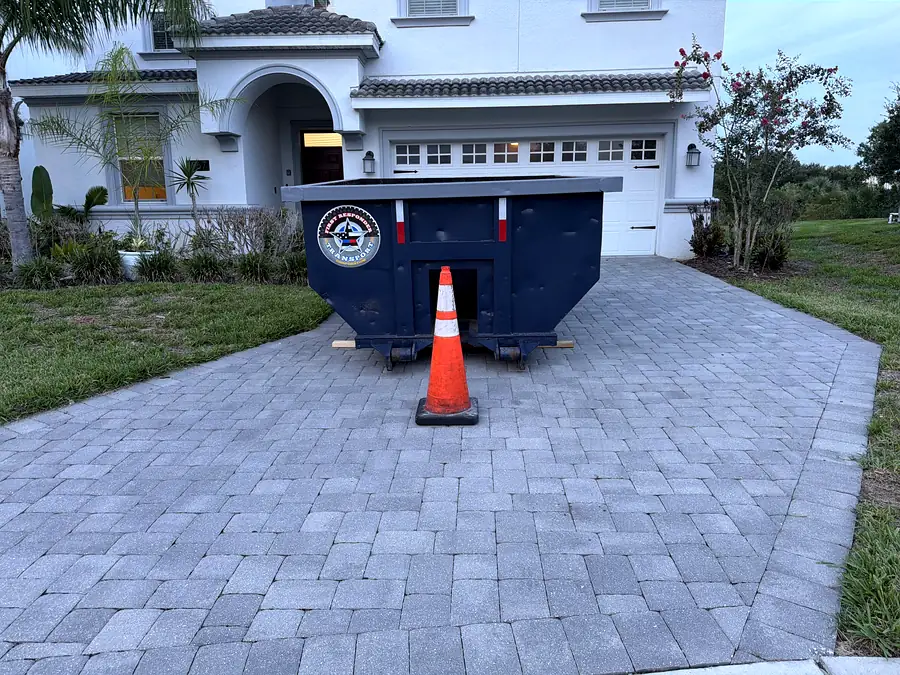
If you are not sure it will fit, send a photo of the driveway along with the one of your junk pile. Between the two of them, you'll get a size and a spot in the same reply.